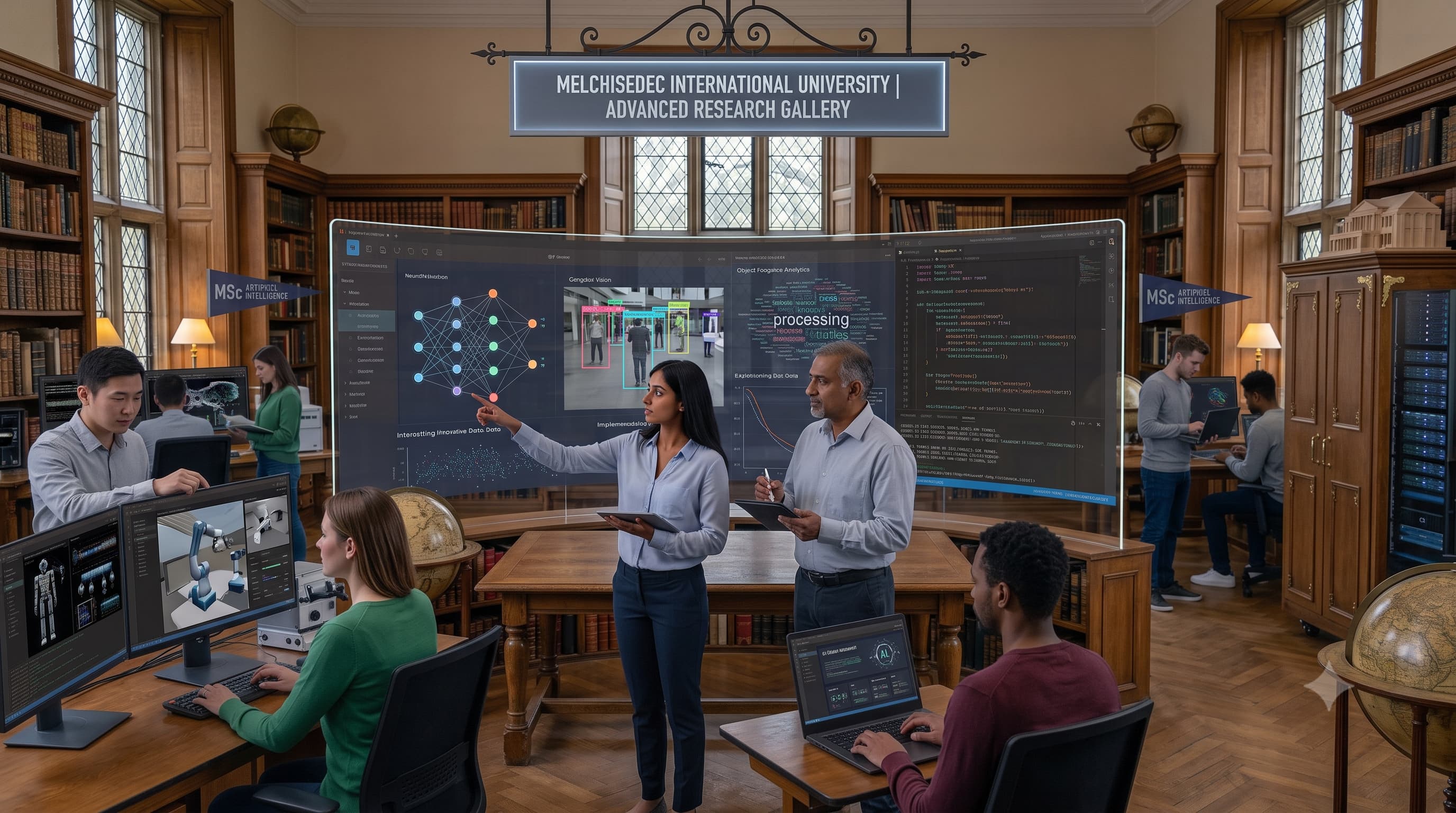
MSc Artificial Intelligence
From Intelligent Ideas to Transformative Solutions
About This Program
Program Description
The Master of Science in Artificial Intelligence prepares students to become advanced AI professionals, researchers, and technology innovators capable of developing intelligent solutions to complex real-world problems.
The program begins with advanced study of the mathematical, statistical, computational, and programming foundations required for artificial intelligence. Students strengthen their understanding of linear algebra, probability, statistics, optimization, algorithms, and computational methods while developing the technical skills necessary to implement and evaluate AI models.
Students progress into advanced areas of machine learning and deep learning, exploring supervised and unsupervised learning, reinforcement learning, neural networks, representation learning, model optimization, and predictive analytics. Through practical projects, students gain experience developing AI solutions using modern programming frameworks, data pipelines, computational platforms, and machine learning environments.
The program provides specialized study in Natural Language Processing and Computer Vision, enabling students to develop intelligent applications capable of understanding language, analyzing images, recognizing patterns, and extracting meaningful information from complex data. Students also explore generative artificial intelligence, large language models, multimodal AI, and emerging foundation-model technologies.
AI systems engineering is another important component of the program. Students learn how to design, integrate, deploy, monitor, and scale AI solutions within modern computing environments. Coursework in cloud computing, MLOps, distributed AI, data engineering, and AI system architecture prepares students to transition machine learning models from experimental environments into reliable production systems.
The program places significant emphasis on responsible and trustworthy artificial intelligence. Students examine ethical, legal, social, and professional considerations surrounding AI development, including fairness, transparency, explainability, privacy, security, accountability, data governance, and responsible deployment. This enables graduates to evaluate not only whether an AI system works, but also whether it is safe, appropriate, and responsible for its intended application.
Research and innovation are central to the master's degree. Research Methods in Artificial Intelligence equips students with the ability to formulate research questions, conduct literature reviews, design experiments, analyze results, and communicate scientific findings. The supervised AI Research Project and Dissertation enables students to investigate a significant artificial intelligence problem and produce an original, evidence-based contribution under academic supervision.
Students may also explore applied AI through industry-oriented projects involving healthcare, finance, education, cybersecurity, business intelligence, robotics, automation, and other emerging technology domains. These experiences encourage students to connect advanced AI concepts with practical organizational and societal challenges.
Graduates are equipped for professional and research-oriented careers in artificial intelligence, machine learning, data science, intelligent systems, AI engineering, computer vision, natural language processing, and AI research. The degree also provides a strong foundation for doctoral study and further research in artificial intelligence, machine learning, computer science, and related disciplines.
Specializations
- Machine Learning and Deep Learning
- Natural Language Processing
- Computer Vision and Image Intelligence
- Generative Artificial Intelligence
- Large Language Models and Foundation Models
- Reinforcement Learning and Intelligent Agents
- AI Systems Engineering
- MLOps and AI Deployment
- Data Engineering for Artificial Intelligence
- Robotics and Autonomous Systems
- Responsible and Explainable AI
- AI Research and Innovation
Core Courses
- AIN 501 – Foundations of Artificial Intelligence
- AIN 502 – Advanced Programming for Artificial Intelligence
- AIN 503 – Mathematics and Statistics for AI
- AIN 504 – Machine Learning
- AIN 505 – Advanced Machine Learning
- AIN 506 – Deep Learning and Neural Networks
- AIN 507 – Artificial Intelligence Research Methods
- AIN 508 – Responsible and Ethical Artificial Intelligence
- AIN 509 – AI Systems Engineering
- AIN 510 – Artificial Intelligence Research Project and Dissertation
- AIN 511 – Natural Language Processing
- AIN 512 – Computer Vision and Image Intelligence
- AIN 513 – Reinforcement Learning and Intelligent Agents
- AIN 514 – Generative Artificial Intelligence
- AIN 515 – Large Language Models and Foundation Models
- AIN 516 – Explainable and Trustworthy AI
- AIN 521 – Data Engineering for Artificial Intelligence
- AIN 522 – Cloud Computing for AI
- AIN 523 – MLOps and AI Deployment
- AIN 524 – Distributed Artificial Intelligence Systems
- AIN 525 – AI Software Architecture
- AIN 526 – AI Security, Privacy and Governance
- AIN 531 – Applied Artificial Intelligence
- AIN 532 – AI Product Development and Innovation
- AIN 533 – AI Applications in Business and Industry
- AIN 534 – Technology Leadership and Professional Practice
- AIN 535 – Emerging Technologies in Artificial Intelligence
- AIN 540 – AI Capstone and Industry Project
Admissions
Entry Requirements
Applicants should hold a bachelor's degree from an accredited university or a recognized equivalent qualification.
Applicants should demonstrate competence in English.
Applicants should satisfy the university's postgraduate admission requirements.
Applicants should have an academic or professional background in computer science, software engineering, information technology, data science, mathematics, engineering, or a related discipline.
Applicants should demonstrate foundational knowledge of programming, mathematics, statistics, and computing concepts relevant to graduate-level study in Artificial Intelligence.
Applicants may be required to satisfy any additional departmental requirements for admission into the Master of Science in Artificial Intelligence program.
What You'll Achieve
Learning Outcomes
Apply advanced mathematical and statistical principles to artificial intelligence problems.
Design, implement, train, and evaluate machine learning and deep learning models.
Develop intelligent systems using contemporary artificial intelligence frameworks and programming methodologies.
Apply natural language processing techniques to language understanding, generation, and text analytics problems.
Design computer vision solutions for image, video, object detection, recognition, and visual intelligence applications.
Develop and evaluate generative AI applications using contemporary foundation models and generative techniques.
Apply optimization and computational methods to improve the performance, accuracy, and efficiency of AI systems.
Design scalable AI architectures using cloud computing, distributed systems, and modern AI infrastructure.
Implement MLOps practices for the testing, deployment, monitoring, and lifecycle management of machine learning systems.
Engineer data pipelines and data processing workflows that support reliable artificial intelligence applications.
Evaluate AI models using appropriate performance metrics, experimental methodologies, and statistical techniques.
Apply research methodologies to investigate emerging problems and technologies in artificial intelligence.
Critically evaluate the ethical, legal, social, security, and professional implications of AI technologies.
Design explainable, trustworthy, secure, and responsible artificial intelligence solutions.
Communicate complex AI concepts, research findings, and technical recommendations to specialist and non-specialist audiences.
Conduct an independent supervised research project that demonstrates advanced knowledge and practical competence in artificial intelligence.
After Graduation
Career Opportunities
A Closer Look
Ready to Enrol in MSc Artificial Intelligence?
Take the first step. Apply today and our admissions team will guide you through every stage.
Admissions Team
24/7 Support
Secure Process